
good kid, m.A.A.d city And How It Conveys The Relationship Between Music And Text.

Updated: May 8, 2023
Music during the Middle Ages and Renaissance was both sacred and secular—some was composed for religious functions and other music was made for entertainment (Forney 64). For the bulk of the Middle Ages, sacred music was far more prominent. Though, as new cultural ideas were being introduced into the western world, music began to be viewed as “both a social activity and a commodity item” (Forney 64). This newfound perception of music not only promoted the enjoyment of secular music, it also inspired creative freedom and expression through composition (Forney 81). The relationship between text and music became deeper, and the idea of humanism rose to prominence. Musicians began putting unique twists on sacred music, first, by experimentation with polyphonic textures.
At the beginning of the Renaissance, imitative and improvised polyphony became a common characteristic in Gregorian Chant (Cumming 3). However, some singers were accused of exaggerated polyphony, often thought of as an insult to sacred music, because it made the text unclear (Forney 80). Nonetheless, “the magnificence and complexity of polyphonic music became increasingly sought after” and experimentation with music began to take off (Forney 81).
Polyphony in the Mass Example:
Missa Papae Marcelli - Kyrie - Giovanni Pierluigi da Palestrina (1525-1594)
European contacts with Eastern cultures gave rise to “the musical style known as Ars nova (new art), which appeared in the early 1300s” (Forney 84). This new art style of music inspired many composers to make their transition from sacred to secular composition (EOM 84). One of the most prominent styles of secular music was chanson, popularized by French poet-composer Guillaume De Machaut (Forney 84). Machaut’s work, which was created from “his own poetry, [commonly] embracing the ideals of medieval chivalry,” inspired the development of styles “linking music and lyric poetry” (Forney 85-87). This brings us to the Italian Madrigal.
Machaut French Chanson Example:
Love song: “Remede de Fortune” http://ezproxy.lib.utexas.edu/login?url=https://search.alexanderstreet.com/view/work/bibliographic_entity%7Crecorded_cd%7C435108?account_id=7118&usage_group_id=114746
Around the year 1520, the Italian Madrigal was born (Macey and Cummings 263). Taking much inspiration from the French chanson, the Italian Madrigal was focused on Italian poetry (Macey and Cummings 263). This Italian music style was known for “setting emotions to music” through the art of “word painting” which emphasized the relationship between music and text (Hansen 158). Word painting is “how a composer metaphorically paints a word with sound or musical gesture” (Beach and Bolden 751). An example could be an “unexpected harsh dissonance [in a song], [that might] coincide with the word ‘death’” (Forney 88). Over the decades, word painting has been continuously employed in music composition, however, the way it is used today is much more modernized. Inevitably, over time, word painting has been molded to fit the ever-changing musical trends of one era to the next. While word painting might not incorporate the same techniques as it did hundreds of years ago, the art is still seen in many works of music heard today. A work that I consider to be one of the most pivotal albums in the Hip Hop/R&B genre, Kendrick Lamar’s, good kid, m.A.A.d city, exercises the relationship with music and text through the art of storytelling and word painting.
Kendrick Lamar’s debut album, ‘good kid, m.A.A.d city,’ tells a story about a single evening in Compton California. Though the album is not in chronological order, it is understood later on that this is because most songs are written from the perspective of K.Dot, “with a few Kendrick tracks peppering the storyline throughout” (Vice). K.Dot is Kendrick’s persona before getting out of Compton. The identity of K.Dot projects a combination of self-confliction, violence, and faith. Towards the end of the album we see K.Dot finally make his transition to Kendrick Lamar.
The first song in the album begins the narrative (Vice). “Sherane a.k.a Master Splinter’s Daughter,” tells the story about a risky, sex-driven relationship Lamar was in at the time. At the beginning of the song, we hear a tape being put into a player and the sinner’s prayer is recited by a group of male voices. One of the most prominent themes throughout the album is Kendrick’s faith and the ways in which he tries to repent the sins he commits in the streets of Compton. The next song, “Bitch Don’t Kill My Vibe” continues this theme, where in the beginning, Lamar sings, “I am a sinner, who’s prolly gonna sin again, Lord forgive me,” here, K.Dot accepts that he is human- that he is going to make mistakes. He follows this plea for forgiveness with the line “the things I don't understand, sometimes I need to be alone,” which highlights how so many of his mistakes are related to the negative influence of his peers, and that he needs time for introspection. In this song, K.dot begins to realize that he will not be able to make something of himself if he is around his friends all the time. Lamar emphasizes that he only needs his “drink and his music” and he “would share it, but today” he needs a break from everyone. The constant overstimulation of gang violence in Compton has taken a toll on his mental health and if someone tries to interrupt his alone time they will “kill his vibe.”
Sherane and K.Dot
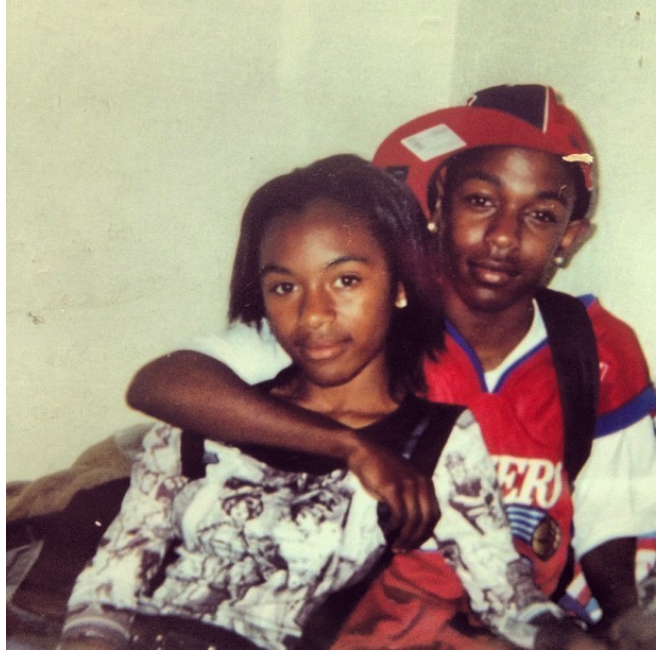
This album represents Lamar’s struggle to find his “existential value and purpose in the world” (Linder 107). Throughout the album, K.Dot weighs the benefits and costs of life in Compton to shape his identity as Kendrick Lamar. What draws K.Dot to Compton is his friends, the loyalty they share for one another, and, of course, the crazy experiences they have. However, K.Dot also recognizes the costs of being in that environment.
In the song “The Art of Peer Pressure,” Lamar tells the story of a robbery he and his friends commit, how peer pressure commonly led him to engage in drugs, crime, and other gang related activity. Like many other songs on the album, Lamar integrates things his “momma” tells him to get him to stay out of the streets. In “Sherane a.k.a Master Splinter’s Daughter,” we hear her voicemail telling Lamar to stop “fuckin' around in them streets [or he] ain't gon' pass to the next grade” and in “The Art of Peer Pressure” Lamar raps, “momma used to say one day it’s gon burn you out.” Aside from faith, Lamar's “momma” plays a big role in helping him make his transition from K.Dot to Kendrick Lamar. She helps K.Dot see through crime and violence, helping him find his way out.
Kendrick and his “momma” Paula Oliver

In the two-part song “Sing About Me, I’m Dying of Thirst,” Kendrick tells stories from the perspective of a black man and woman, while trying to answer the “the question [of] whether life has meaning in the brutalized urban environment of Compton” (Linder 107). Both dialogues in the song are directed at Kendrick, telling him what has happened in regard to their lives on the streets of Compton. The first perspective is Kendrick’s friend who was killed in the streets but before he died, asked Lamar to sing about him. The next perspective depicts a black woman who sells herself on the streets of Compton. Kendrick then proceeds to ask himself, “am I worth it? Did I put enough work in?” (Linder 107). Lamar questions his worth in general and his worth in the “working world” as a rapper.
His friends act as an anchor pulling him down to Compton, and we see this through “The Art of Peer Pressure” and “Bitch Don’t Kill My Vibe” where K.Dot explains how he can not relate to his friends because it seems they lack empathy for the many lives that have been lost in the streets. In the music video, he conveys his need for a break by distancing himself from the people sitting together at the funeral. He stands in an empty field as he raps the song to further depict his desire to be alone. In the video we also see him partying and drinking with his friends in a limo leaving the funeral, as he sings, “I am trying to keep it alive and I compromise the feeling we love.” This line tells us that even though he was mentally exhausted from the constant trauma and death he experienced in the streets of Compton, he still acted the part around his friends.
Kendrick Lamar in his music video for “Bitch Don’t Kill My Vibe”


The song “swimming pools” also expands on the power of peer pressure. Lamar paints a scene where he is drinking casually, when one of the people he is with tells him he needs to drink way more. When the speaker lists out the stages of being dangerously intoxicated, “sit down, stand up, pass out, wake up, faded...” Lamar uses word painting by creating a warped sound in the song to portray the feeling of being drunk. Lamar alludes to alcoholism throughout the album but in this song he dives into it (literally, a swimming pool full of alcohol). Lamar even has his conscience speak to him in the song when he is close to blacking out. His conscience tells him to stop drinking or else he will “poison” himself. The song “good kid” also uses word painting, when we hear “mass hallucinations baby” there is a reverb combined with vibrato that makes it seem like a hallucination. One of the last songs, “Real,” establishes K.Dot’s final transition into Kendrick Lamar. He has “shed the character of K.Dot and the negative connotations of growing up in Compton. He’s real. He’s real. He’s really, really real” (Vice). The song ends with another one of his momma’s voicemails. She tells Kendrick that a friend came by that wants to record with him and that he needs to “tell [his] story to black and brown kids in Compton” so that they can see that there is a way out.
“The Art of Peer Pressure” is the song that resonates with me the most in the album. Simply because I am a victim of peer pressure myself, almost every day, and it has been especially prominent in college. This song keeps listeners on the edge of their seats as K.Dot tells a story about a risky night out “with the homies.” K.Dot begins by telling everyone to listen to his story on Rosecrans Avenue, the street that Kendrick Lamar grew up driving down in Compton California. The street, known for its gang violence around certain areas, “is a major [27-mile-long] west-east thoroughfare in Los Angeles and Orange Counties, California, USA.” The main theme in “The Art of Peer Pressure” is, well, peer pressure, the act of being coerced by your friends to do things that are not particularly good. The story K.Dot explains is a robbery that he and his friends commit purely on adrenaline. They start stealing stuff from a house when they notice that someone is home and call the cops on them. They run out of the house and get into a high speed chase with the police that ends in their favor. K.Dot reflects on who he really is without the peer pressure throughout the song. “Really, I'm a peacemaker, Really I'm a sober soul”….But I'm with the homies right now” and “that's ironic, 'cause I've never been violent, until I'm with the homies. These are all moments Kendrick realizes how much he gives in to peer pressure, how he will do anything for his friends, to have their back, to be cool, to be bold. He questions himself, well I am normally a “peacemaker,” but right now I would shoot a guy dead, rob a house, rob a liquor store, and take “a shot of Hennessy,” for my friends. “Look at me, I got the blunt in my mouth, usually I'm drug-free, but shit, I'm with the homies.” His loss of innocence is a dominating theme throughout the entire album. Whether it was pressure from his rise to fame or from his close friends, Lamar's life has been nothing but a battle to stay humble and true to himself, even if he feels alone in that.
Lamar's music shines a light of hope on those struggling to get out of a life consumed by crime and poverty. He has shown the world that someone who started at the bottom can make it to the top, showing that life takes incredible persistence and integrity to be the person you want to be and to reach your goals. He continues to inspire equality and change in society, using stylistic choices like word painting within his music to personalize experiences and inspire emotions within his audience.
Kendrick Lamar is a Black musician, activist, realist, preacher, brother, son, and an inspiration to all.
Rosecrans Avenue


Cites
Bassil, Ryan. “The Narrative Guide To Kendrick Lamar’s ‘good kid, m.A.A.d city.’” Vice Magazine, 2013. https://www.vice.com/en/article/65penb/the-narrative-guide-to-kendrick-lamars-good-kid-mad-city
Beach, Pamela, and Benjamin Bolden. “Word Painting: Using a Musical Technique to Enhance Vocabulary.” The Reading teacher, vol. 72 no. 6, 2019, pp. 750–754. https://web-s-ebscohost-com.ezproxy.lib.utexas.edu/ehost/detail/detail?vid=0&sid=d1f0eaae-161e-4109-a14b-75cbf3ce2432%40redis&bdata=JnNpdGU9ZWhvc3QtbGl2ZQ%3d%3d#AN=136091272&db=a2h
Cumming, Julie, “Renaissance Improvisation and Musicology,” Society for Music Theory, vol. 19 no.2, 2013, pp.1-5. https://mtosmt.org/issues/mto.13.19.2/mto.13.19.2.cumming.pdf
Forney, Kristine and Andrew Dell'Antonio. “The Enjoyment of Music,” 2013.
Hansen, Niels Chr. “A Call for Hypothesis-Driven, Multi-Level Analysis in Research on Emotional Word Painting in Music: Commentary on Sun & Cuthbert.” Empirical Musicology Review, vol. 13 no.3-4, 2019, pp.158-163. https://search.lib.utexas.edu/discovery/fulldisplay?docid=cdi_doaj_primary_oai_doaj_org_article_c612eb3b3a3e44ab8637bbe257024132&context=PC&vid=01UTAU_INST:SEARCH&lang=en&search_scope=MyInst_and_CI&adaptor=Primo%20Central&tab=Everything&query=any,contains,%22word%20painting%22&offset=0
John, Jason “Kendrick Lamar Parents- Paula Oliver, Kenny Duckworth,” Empire BBK, 2017 https://empireboobookitty.com/kendrick-lamar-parents-paula-oliver/
Linder, Matthew. "''Am I Worth It?'': The Forgiveness, Death, and Resurrection of Kendrick Lamar." Toronto Journal of Theology, vol. 33 no. 1, 2017, p. 107-112. Project MUSE https://muse-jhu-edu.ezproxy.lib.utexas.edu/article/664536
Macey, Patrick, and Anthony M. Cummings. “Renaissance Quarterly,” The University of Chicago Press, Renaissance Society of America, vol. 61, no. 1, 2008, pp. 263–64, https://doi.org/10.1353/ren.2008.0089
Roberts, Randall. “Rolling down Rosecrans in Compton, L.A. hip-hop’s Main Street,” Los Angeles Times, 2018. https://www.latimes.com/entertainment/music/la-et-ms-hip-hop-rosecrans-20180118-htmlstory.html
“Sherane AKA Master Splinter's Daughter,” Reddit, 2019. https://www.reddit.com/r/KendrickLamar/comments/a6hg7p/sherane_aka_master_splinters_daughter/

Comments